The Trunk in the Basement: Family Keepsakes and the Uneasy Work of Mountie Memory
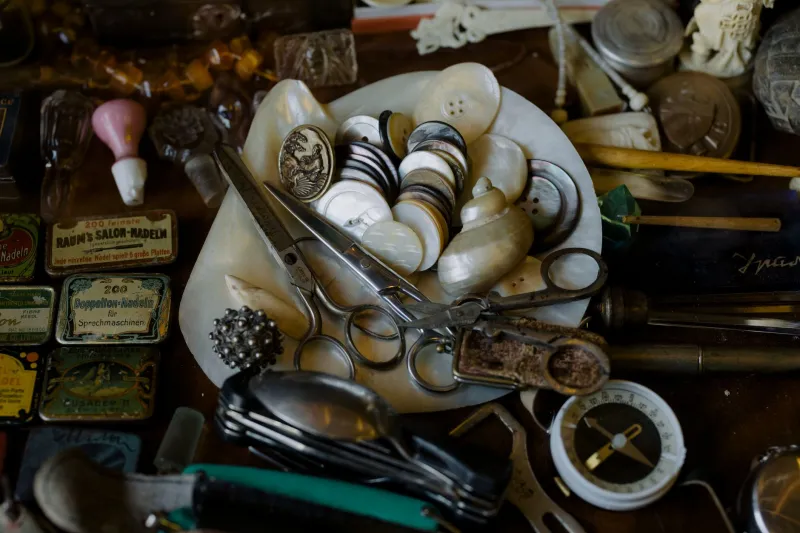
In many Canadian homes, the archive of an RCMP career is not housed in a climate-controlled vault. It sits in a trunk in the basement, a cardboard box on a closet shelf, or a drawer that has not been opened since a parent moved into a care home. The contents are rarely dramatic. A handful of uniform buttons. A cap badge kept in tissue. A steno pad with pages torn out. A transfer letter on brittle paper, its margins crowded with a date and a post office box. These are the domestic remains of a working life in policing, and they raise a question that museums and podcasters are increasingly obliged to answer: who gets to decide what a Mountie's memory means?
The Objects That Outlast the Posting
Official histories tend to favour the ceremonial and the exceptional—the red serge, the Musical Ride, the famous investigation. Family collections are more ordinary and, for that reason, more revealing. A retired member's papers may include mess receipts, a CPR timetable from a northern posting, a dog handler's lead, a citation for long service, or a photograph of a detachment office with a wood stove and a single telephone. None of these items would anchor a display case on its own. Together, they describe the texture of police work as it was actually lived: administrative, repetitive, improvisational, and deeply local.
The objects also carry a second layer of meaning that is not evident on their surface. A transfer letter is not merely a bureaucratic notice. In a family, it may mark the month a child changed schools, a spouse gave up a job, or a household learned to measure time in postings rather than years. A steno pad may contain nothing more than times and initials, but its presence in a family box suggests how often the work followed a member home—not as danger, necessarily, but as habit.
What a Notebook Can Say Without Speaking
Family keepsakes are often valued for what they do not explain. A notebook with a missing page can be more eloquent than a complete diary. Relatives may know the outline of a case or a posting but not the details, and they may have chosen not to ask. Policing culture has long rewarded discretion, and that discretion does not end with a pension. It becomes part of the household atmosphere, a set of boundaries that children learn before they can name them.
For public historians, this creates an interpretive problem. The temptation is to treat the object as a key that will unlock a story. In practice, the object often confirms that a story exists while withholding its content. A button is not evidence of a particular arrest. A photograph of a detachment does not identify the people in the background. The responsible response is not to press harder but to describe the limits of the record honestly. Families are not withholding evidence from a court; they are managing the terms on which a private life becomes public.
The Privacy Ledger
When a family considers donating to a museum or speaking with a researcher, it is negotiating several interests at once. There is the wish to honour a career, the wish to protect surviving colleagues, and the wish to avoid reducing a complicated person to a set of anecdotes. There is also the practical matter of names. Police files frequently involve third parties—complainants, witnesses, people who were never charged—whose privacy does not expire simply because a researcher is curious.
Donor agreements can address some of this. Archives may accept material with restrictions, closing certain files for a period or requiring that names be removed. But paperwork does not resolve the underlying tension. A family may be asked to explain why an item matters, and the explanation may be incomplete, contradictory, or simply unavailable. That is not a failure of memory. It is the ordinary condition of family history, which is rarely organized for the convenience of outsiders.
When Institutions Come Asking
Museums, university archives, and independent researchers all approach family collections with different expectations. An institution may be interested in provenance and conservation. A podcaster may be interested in narrative and voice. A local historical society may be interested in the detachment's place in a town's story. Each approach carries an implicit request: help us make sense of this. Families are entitled to decline, to donate selectively, or to set conditions that reflect their own sense of propriety.
The better encounters tend to begin with an acknowledgment that the family is not a branch office of the archive. It is a separate custodian with its own reasons. A relative may keep a uniform jacket because it still smells of a particular house, or because it was worn at a wedding, or because no one has yet decided what else to do with it. These reasons are not obstacles to public history. They are part of the history of how policing is remembered in Canada—less through official commemorations than through the quiet decisions of households.
The Question Worth Asking
The trunk in the basement is not a museum waiting to be catalogued. It is a holding place for objects that have outlived one context and have not yet entered another. Asking what a family keeps is useful. Asking why they keep it, and on what terms they might share it, is more useful still. Public history gains when it admits that some stories arrive incomplete, and that the people who hold them are not merely sources but custodians of a private life that happened to be spent in uniform.