Before the Siren, the Voice: Rural RCMP Radio Roomsと the Human Filter of Dispatch
Long before a cruiser's lights touched a gravel shoulder, someone in a small room was already listening. In RCMP detachment towns across Canada, the radio operator sat at a console that connected an officer on a rural road to the nearest thing the force had to a local switchboard. The job was part communications, part record-keeping, and part judgment. It was rarely glamorous. It was often indispensable.
This article considers the radio room between the 1970s and the early 2000s, when many detachments still relied on local operators and dispatchers. It draws on themes found in archival training materials and oral histories: procedure, geography, voice, and the quiet welfare work that seldom made a file. The point is not to romanticize the past. Regional dispatch centres brought real gains. The point is to account for what a local radio room did that a distant console could not.
The Console as Local Infrastructure
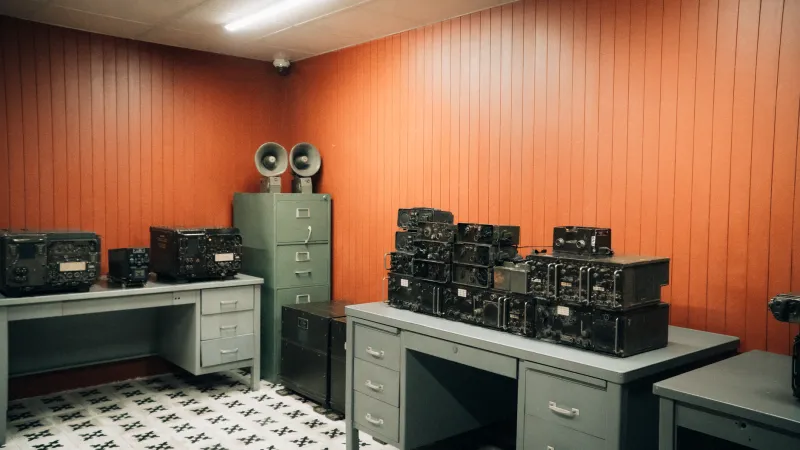
A detachment radio room was not simply a desk with a microphone. It held a base station, a telephone, a logbook, a map board, weather reports, and the accumulated clutter of a place where people worked shifts. The operator might be a civilian employee, an auxiliary member, or a sworn officer assigned to the desk. In smaller posts, the role blurred into clerical work and front-counter duty. The person who answered the phone might also be the person who dispatched the car.
Training materials from the period stressed the basics: clear speech, correct call signs, accurate logging, and calm under pressure. Those skills were teachable. The unwritten curriculum was local. An operator learned which bridge iced first, which farm lane had no visible sign, which elder lived alone, and which officer could be reached at home when the radio failed. In a rural detachment, geography was not an abstraction on a screen. It was a set of names and distances held in memory.
Procedure With a Pulse
The manuals were formal for a reason. Radio traffic had to be brief, disciplined, and unambiguous. Call signs, phonetic alphabet, status checks, and ten-codes created a shared language. The log recorded time, caller, location, and action. Confidentiality mattered. So did accuracy. A misheard road name could send a car in the wrong direction; a missed status check could leave an officer unaccounted for.
Yet procedure alone did not explain the role. The same voice that handled a stolen tractor might also handle a cardiac arrest, a domestic disturbance, or a missing child. The operator had to sort urgency from noise. Oral histories from the period often describe the dispatcher as a voice rather than a face: familiar, steady, and present in moments of fear. That presence was not soft sentiment. It was operational. A caller who could be calmed gave better information. An officer who knew someone was listening took fewer risks.
The Welfare Check Nobody Logged
Much of the work was mundane. Operators relayed messages, checked weather, tracked tow trucks, and told callers to lock their doors. But the radio room also performed a kind of informal welfare check. If a member missed a scheduled call, the operator noticed. If a voice sounded strained, the operator might ask a second time. If a storm cut off a road, the operator knew which cars were out and who was due back.
These acts rarely appeared in formal reports. They were part of the rhythm of a shift. The operator was a human filter between the public and the police, deciding what needed a cruiser and what needed a conversation. That discretion was not a substitute for policy. It was the local application of policy by someone who knew the community.
When the Room Went Quiet
From the 1990s onward, regional dispatch centres, computer-aided dispatch, digital radio, and mobile data terminals changed the work. Consolidation promised consistency, redundancy, and professional oversight. It delivered advantages: specialized training, recorded lines, and coverage that did not depend on one person in one small room. For a national police force operating across vast distances, those gains mattered.
The losses were subtler. A regional centre might know the file but not the family. It might know the highway number but not the bridge. The voice on the radio became more standardized and less familiar. That was not necessarily worse. It was different. The local operator had been a memory aid, a welfare check, and a familiar point of contact. When the room went quiet, some of that local knowledge went with it.
What the Archives Can and Cannot Say
Archival training materials can show how operators were taught to speak and log. They cannot fully capture how a room sounded at 3 a.m. Oral histories can. As of 2026, many former operators are aging, and many local radio rooms have been repurposed or erased. The records that remain are fragmentary: manuals, logbooks, photographs, and memories.
That makes collection urgent without making it sentimental. The history of Canadian policing is not only a history of raids and investigations. It is also a history of people at desks, listening. The codes have changed. The need to be heard has not.