Ink Before the Lens: What the Mountie's Notebook Knew About Evidence

Every few years, Canadian policing rediscovers the same argument. A video surfaces, or fails to surface, and the public asks who is telling the truth about what happened. In 2026 the question tends to arrive attached to a lens: the RCMP's body-worn camera program, announced in 2024 and still being extended detachment by detachment, has made the question of recorded proof a permanent feature of the national conversation.
But the Force has been answering that question for well over a century. For most of its history, the record of an incident did not begin with a lens. It began with a bound notebook, a pen, and a member standing in the cold, writing down what he had seen while he could still see it.
A Pocket-Sized Duty
In the early decades of the North-West Mounted Police, and later the Royal Canadian Mounted Police, the notebook was less a tool than a piece of kit — issued, inspected, and expected to be present. Commissioner's Standing Orders and detachment routines treated documentation as a discipline in its own right. Members recorded patrols, complaints, weather, horse fodder, and the small human disputes that made up most of a prairie posting. The entries were not written for historians. They were written for the next constable on the same patrol, and for a magistrate who might read them months later.
What those pages reveal, to anyone who has spent time in the archives, is a working culture in which the written word carried a quasi-legal weight long before anyone called it evidence. A note made on a Tuesday night in a rural detachment could surface years later in a courtroom in a different province. Members understood this, and the Force's training reminded them of it. The notebook was, in practical terms, the first body camera: a recording device that captured a scene in real time, from the perspective of the officer present, with all the strengths and all the limitations that implies.
The Word and the Page
Canadian courts have always been uneasy with the phrase "it's in my notes." Judges have long accepted that police notes may be used to refresh a member's memory, that they must be disclosed to the defence, and that their absence invites difficult questions. The Mountie's word has never been sufficient on its own; the page has always been the corroboration.
This is where the historical tension sits. The Force's reputation — the red serge, the reliability, the institutional voice — rests on a presumption of credibility. The notebook exists precisely because that presumption was never quite enough. Every serious Canadian inquiry into policing in the twentieth century returned, at some point, to the quality of the written record: what was noted, what was not, when it was written, and by whom. Public inquiries into police conduct in the 1970s and 1980s, including the McDonald Commission's examination of RCMP wrongdoing, wrestled with the difference between what the Force said about itself and what its own files could show. The lesson was not that members lied. It was that records, when they are thin or missing or written days late, cannot carry the weight a community needs them to carry.
Photographs in the Archive
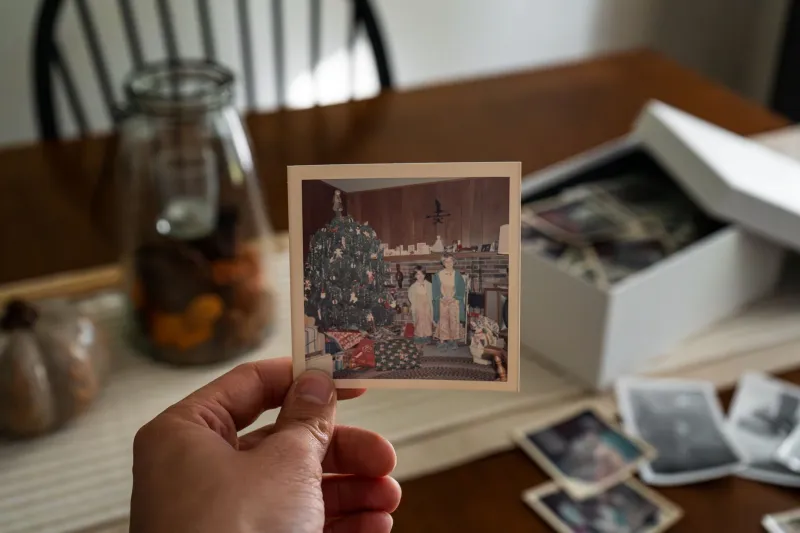
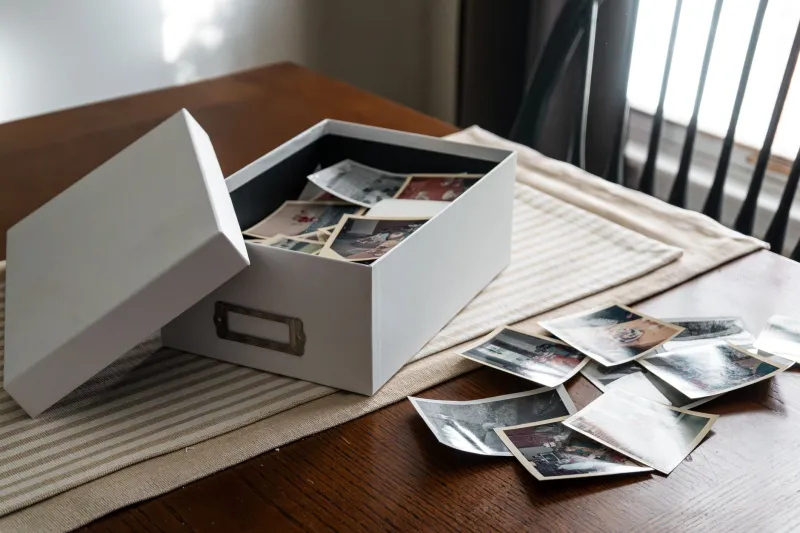
The archives hold the companion to the notebook: the evidence photograph. Crime scene plates, scene-of-occurrence images, photographs of seized property — these are among the most quietly revealing holdings in any Canadian institutional collection. A photograph from a 1930s detachment shows a table, a label, a ruler. It is not dramatic. It is merely proof that someone thought carefully about what a stranger would need to see decades later.
That instinct — anticipating the later reader — is the whole ethic of evidence work. It is also the standard against which any recording device, film or digital, ought to be judged. A camera that captures an incident but not its context has not solved the problem the notebook was designed to solve. It has only moved it.
What the Lens Inherited
Body-worn cameras are often described as though they resolve the credibility question. They do not. A lens has a field of view, a moment of activation, an off-button, and a chain of storage and disclosure that can be contested as vigorously as any notebook. In many ways the digital record is more demanding than the paper one, because metadata invites scrutiny that ballpoint never did: timestamps, gaps, buffer periods, and the particular Canadian problem of privacy law in a federated system where provincial oversight bodies each have their own view.
Still, the underlying argument has not changed in a hundred years. Canadians want to know that the account of an incident — the official account, the one that becomes a file and eventually a fact — is produced honestly, close in time to the event, and open to challenge. The notebook answered that need imperfectly. So does the camera.
The Question That Doesn't Retire
In the detachment museums and the provincial archives, the notebooks sit in acid-free boxes, their pages largely unread. They are not relics of a naive era before accountability mattered. They are evidence that accountability was always the point, and that it was always contested.
When the current debate over cameras reaches a saturation point, as these debates do, it may be worth remembering that the RCMP's first recording device fit in a breast pocket and came with no battery life at all. It worked, more or less, for the same reason any record works: because someone wrote it down while it was still true, and because someone else was entitled to read it later.
That entitlement — the public's right to examine the record — is the through-line. Cameras are new. The question of who gets to check the account is not.