Between Stations: The Quiet Craft of Policing Canada by Rail
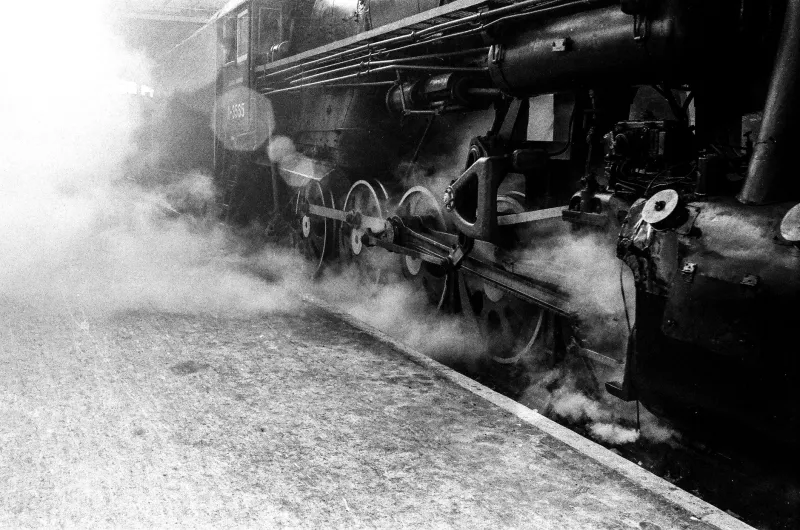
Long before the highway cruiser became the standard image of rural policing, the RCMP's reach often depended on steel. In the early decades of the twentieth century, members travelled on scheduled passenger and mail trains through districts too large, too empty, or too seasonal for regular patrol cars. The railway was not simply transport. It was a moving observation post, a courier system, and a social institution with its own hierarchy of station agents, section crews, express messengers, and passengers who knew exactly who was aboard.
The railway patrol is easy to overlook because it produced few cinematic moments. There was no siren, no pursuit, no radio call. Instead, there was a timetable. A member might leave the train at a remote siding, conduct enquiries among a handful of households, and catch the next scheduled service days later. Policing from the rail line required patience, a good notebook, and an understanding that presence itself could be a form of order.
A Detachment That Moved
For members assigned to rail work, the carriage served as a temporary detachment. It was a place to write reports, compare notes with the conductor, and watch the small rituals of departure and arrival. The train also carried the force's paperwork—warrants, correspondence, and occasionally prisoners—through country where a road might be impassable for weeks.
The work was less about dramatic intervention than about maintenance. A Mountie on a mail train might check on a disputed property line, follow up on a missing-person report, or simply let a settlement know that the police had not forgotten it. In districts where the nearest detachment was hundreds of kilometres away, the train was the most reliable link between the force and the people it served.
This was especially true in parts of northern Ontario, the Prairie west, the British Columbia interior, and the Yukon, where rail lines preceded reliable roads. The railway created its own geography of policing. A member learned which sidings had year-round residents, which station agent kept the most accurate local gossip, and which section crew would notice a stranger before anyone else did.
The Intelligence of the Siding
Station agents were often the first to see trouble coming. They sold tickets, handled freight, and watched the platform. Section crews maintained the track and knew when a bridge was failing, when a culvert had washed out, or when someone had been walking the line who should not have been. These were not informants in the formal sense. They were the everyday infrastructure of rural knowledge.
RCMP members who worked the rails learned to cultivate those relationships without treating them as surveillance. A conversation on a platform could yield more useful context than a formal statement taken weeks later. The train imposed a social closeness that is difficult to recreate in a modern patrol car: the same faces, the same schedules, the same pauses between stations.
Oral histories preserved by detachment museums and community archives tend to dwell less on arrests than on this social geography. Retired members recall the conductor who knew every local feud, the agent who kept a kettle on for the police, and the long waits at junctions where the only sound was the ticking of a stove. These recollections are not nostalgic filler. They describe a method of policing that depended on familiarity rather than speed.
Mail, Manifest, and Memory
The mail train carried more than letters. It carried court documents, exhibit parcels, and the small administrative threads that held a far-flung district together. For the RCMP, the train was a secure conduit in an era when a courier might be a farmer with a horse and a willingness to help.
The railway also shaped how members understood their own authority. A Mountie on a train was visibly part of a public system, not an isolated enforcer. The uniform invited comment, complaint, and sometimes casual conversation. Passengers might ask for directions, report a theft, or simply offer an opinion about the government. The carriage was a forum as much as a vehicle.
That visibility had limits. Railway patrols could not respond quickly to emergencies, and they depended on schedules that were not designed for police work. A crime might be reported at one stop and investigated only when the member returned. The system worked because rural life itself moved at a different pace, and because the train's regular passage created a predictable point of contact.
The End of the Line
By the 1950s and 1960s, improved highways, radio communications, and the consolidation of detachments reduced the need for regular rail patrols. The railway did not disappear from policing, but it ceased to be the primary artery of rural law enforcement. The mail train gave way to the highway, and the platform conversation gave way to the radio call.
In 2026, the RCMP's relationship with remote communities is still shaped by questions of distance and presence. The old railway patrols offer a useful reminder that presence is not only a matter of vehicles or technology. It is also a matter of rhythm, routine, and the willingness to show up at the same place often enough to be known.
The Mountie on the mail train belongs to a Canada that no longer exists in quite the same form. But the craft it required—attention, patience, and a working knowledge of the people between stations—remains part of the force's inheritance. It is a quieter story than the highway pursuit, and in its own way a more revealing one.