When the Last Post Plays and the Radio Hums: Remembrance Day at a Working Detachment
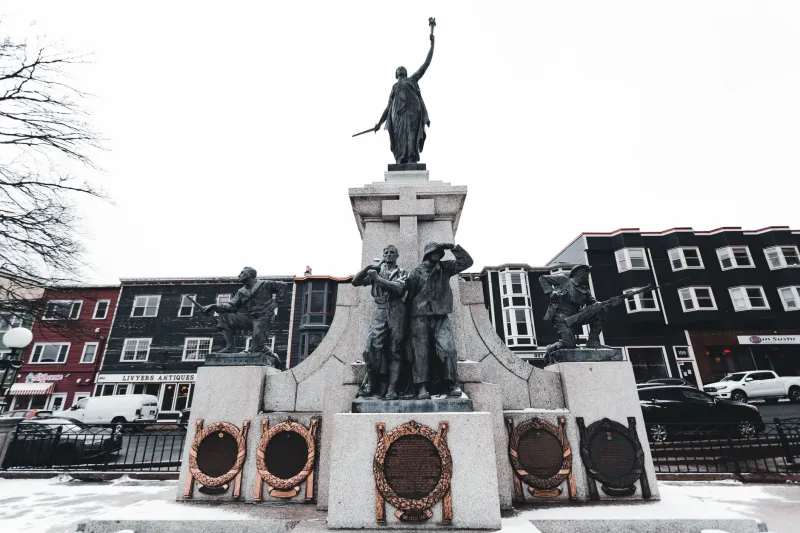
At 10:55 on the morning of 11 November 2026, the light in much of Canada will be thin and grey, and in communities from the Fraser Valley to the Avalon Peninsula, small groups will gather at cenotaphs. Some will be led by a colour party in red serge. The members will have checked their kit, polished their boots, and confirmed that someone else is covering the phones. Then they will march to the stone, take their places, and stand at attention while a bugler plays the Last Post.
A few kilometres away, or perhaps a few hundred metres, a detachment radio will still be on. The dispatch channel will hum. A call may come in for a domestic disturbance, a vehicle in the ditch, a sudden death, a missing teenager. The ceremony does not stop the queue, and the queue does not erase the ceremony. Both belong to the same working day.
The Colour Party as a Local Institution
In the popular imagination, the RCMP colour party belongs to Ottawa and the National War Memorial, to the televised wreath-laying and the slow march past the Governor General. In practice, it is a local institution. Detachments supply members for legion ceremonies in towns where the branch hall seats eighty people and the cenotaph bears names that still belong to families in the area.
The arrangements are rarely dramatic. A corporal confirms the timing with the legion president. A constable volunteers to carry the Canadian flag. Someone checks whether the detachment has a guidon available and whether the weather will permit the wool tunics to stay presentable. In smaller detachments, the schedule is built around shifts. A member may come off a night shift, attend the ceremony, and return to the office to complete files. Another may stand at the cenotaph while a colleague listens for the radio inside the detachment.
Retired members describe this as ordinary rather than exceptional. The colour party is not a performance put on for public relations. It is a courtesy owed to the community and to the dead, and it is fitted into a day that has not been cleared of other obligations. The result can look slightly improvised to an outsider: a ceremony conducted with precision, attended by people who know they may be called away at any moment.
The Radio Doesn't Take a Moment of Silence
The two minutes of silence are the centre of Remembrance Day. For a working detachment, those two minutes are also a period of coverage. Dispatch does not close. The front counter does not lock itself. Someone is on duty, and that person is usually aware that the public expects the ceremony to proceed undisturbed.
There is no standard national rule that every detachment follows in identical fashion. Local practice varies. In some places, members on duty observe the silence at their desks or in the radio room. In others, a supervisor coordinates coverage so that one person can step outside and stand with the colour party while another remains at the console. Portable radios may be carried by members at the cenotaph, turned low, or left with a colleague who knows how to reach them. The task is to keep faith with both obligations.
That tension is not a flaw in the ceremony. It is a reminder of what the ceremony is about. Policing is a service that does not fully stand down. The people who keep the line open are part of the same act of remembrance, even if they are not visible in the photograph of the colour party. Their silence is a working silence, held in a room with a clock and a radio and a list of calls waiting to be dispatched.
Two Halves of One Story
Canadians often think of Remembrance Day as a military observance, and it is. But the RCMP has its own history of service and loss, and many members have served in uniformed roles that connect directly to the broader national story. The RCMP memorial at the training depot in Regina records the names of members killed in the line of duty. Local detachments have their own informal memories: the member who died on a highway, the one who did not come back from a call, the one whose name still comes up when a veteran officer tells a story.
A colour party at a small-town cenotaph brings those two histories into the same frame. The red serge is familiar to Canadians, but it is also a working uniform. The member wearing it may have spent the previous evening taking statements. The ceremony is not a departure from that work. It is a public expression of what the work is for.
The best local ceremonies are unpretentious. A legion chaplain says a few words. A cadet lays a wreath. Someone reads In Flanders Fields. The population is not large, and the silence is not perfect. A truck may pass. A child may ask a question. The colour party stands steady. The radio, somewhere, continues to monitor.
What Remembrance Looks Like From the Duty Desk
For the members who remain behind, the day has its own rituals. The front counter may be quiet for an hour, then busy. The dispatch room may be calm, then urgent. In some detachments, members take a few minutes at 11 a.m. to stand together, if staffing allows. In others, the moment passes with a glance at the clock and a continued attention to the console. Neither response is a failure of respect.
What matters is that the day is marked. Remembrance does not require a perfect pause in the life of a community. It requires attention. The colour party attends. The duty officer covers. The public sees the red serge at the cenotaph and the detachment sign on the door, and understands that these are not two separate institutions. They are the same institution on the same day.
By early afternoon, the ceremony will be over. The flags will be furled, the tunics will be returned to their cases, and the radio will still be on. The queue will resume. Remembrance, in a working detachment, is not a break from duty. It is one of the ways the duty is understood.